
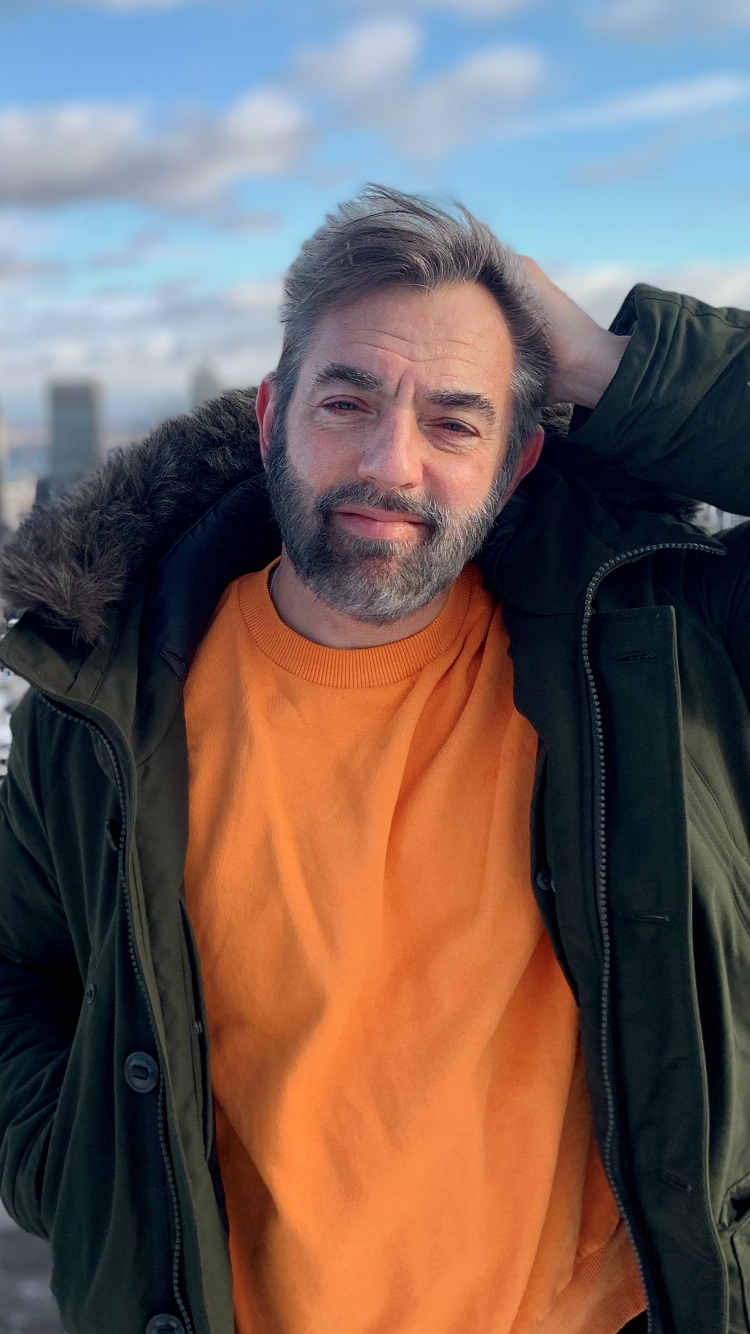

Like many folks, I’m on a daily text thread with three of my closest Judys (as the young queers, perhaps in a sweet nod to the original gay icon Judy Garland, are calling their friends these days). It’s Mark, Kevin, John, and me. We’re all gay men in our 50s, and we’ve all been living with HIV from anywhere between the early to mid-’90s to the early to mid-aughts. Mark and Kevin were diagnosed in 1994, I in 2001, and John in 2005. That makes us all members of the “shoulda known better” generation — too young to claim we didn’t see AIDS coming and too old to have shielded ourselves with PrEP.
Anyway, we all think the word “AIDS” is the best punchline ever, and we use it constantly in our texts. We’ll say: “Leave me alone, I have AIDS!” or “I’m feeling AIDSy today!” Or about our longtime favorite (and now recently defunct) New York City diner, The Dish, an uber-gay hangout: “You could get AIDS just from walking in there!”
Now let me be clear: With the exception of Kevin, whose T cells once dropped slightly below 200 (the longtime medical definition of AIDS) even though he never had symptoms, none of us has ever actually had AIDS. As far as getting HIV goes, we were “lucky” to get HIV either a few years before or after the advent of highly effective, lifesaving cocktail therapy.
Yet when we joke about “AIDS,” we’re tapping into some collective shared history as middle-aged New York City gay men. Kevin and John moved here in the ’80s, Mark and I at the start of the ’90s. John was one of the fresh-faced babies of ACT UP. The rest of us have all been involved in HIV/AIDS work or activism in one way or another — me as a journalist, the others as intermittent fundraisers, community organizers, and activists. We all know people who died of AIDS.
As someone who was already writing about advances in HIV treatment in 2001 when I was diagnosed, I truly never worried I would die from HIV. But it was different for my friends. Says Kevin: “I 100 percent thought I was going to die and I wasn’t happy about it.” Says Mark: “I was positive I was going to die before I reached 30. It was pretty heavy hourly terror, to be honest.” And even John, diagnosed in the mid-2000s, says: “I told my therapist a week after I seroconverted that I was now living life on a timeline.”
Moreover, as sexually active gay men, we certainly lived, pre-diagnosis, with the fear of getting HIV, and post-diagnosis, with our share of angst about disclosing our status to sexual partners — not to mention outright rejection because of our status. About a decade ago, right before PrEP, I had a hook-up who was virtually panting with lust, no mention of condoms, suddenly turned stone cold when I told him I was HIV-positive. As we arrived at our highly anti-climactic climax, after a long and mood-killing talk about “the issue” of AIDS, he stood three feet away from me holding up a strip of paper towels as though he were a toreador warding off, rather than luring, a bull toward him. It was unsexy, to say the least.
Joking About the Word ‘AIDS’
For all these reasons, we feel we’ve earned the right to joke about the word “AIDS.” And let’s face it, there’s something just funny about the word. Like “abortion,” “Holocaust,” or “slavery,” it’s so politically and historically charged that it almost begs to be made a punchline. I firmly believe that the group that “owns” an issue (gays, Jews, Blacks, women) has a right to joke about it. It’s a way of letting off steam and turning pain into laughter.
Yet, as I wrote recently on my Substack, I don’t think outside groups have a right to make jokes about painful stuff that is not part of their community and history. I’m speaking morally, not legally. I don’t believe in censorship, and I generally believe that anyone has a right to say or write anything they want, but folks should at least be ready for the consequences. That’s why I was among those who thought it was disgusting, rather than funny, when the comic Dave Chappelle, who historically I’ve considered quite brilliant, joked that the young rapper DaBaby in his recent onstage rant in Florida “punched the LBGTQ [sic] community right in the AIDS.” That’s how Chappelle put it in his recent Netflix special, “The Closer,”” which has gotten so much flack for Chappelle’s long tirades against LGBTQ+ people — particularly transgender people, whose very authenticity he questions and mocks while, strangely, insisting he has nothing against them.
But that’s another story. We’re sticking to “AIDS” here! And let me be clear: I have ambivalence even when AIDS jokes are used in contexts not as pointedly hostile to queer folks as Chappelle was if they’re coming from outside our affected communities. Take the comic Sarah Silverman, who I generally love and consider a queer ally. It’s been years since she made AIDS jokes, such as “I have AIDS — billions of them.” Or “When God gives you AIDS — and God does give you AIDS, by the way — make lemonAIDS!” Even today, just writing them out, they still make me laugh. They’re just so juvenile and wrong. And I know with certainty that Silverman is, and has long been, a friend and ally to queer folks and people with AIDS.
But hearing AIDS jokes from anyone who hasn’t carried at least a little of the burden of AIDS, as either a person living with it or part of a community that’s been heavily hit by it, still kind of rubs me the wrong way. Who exactly was she to make those jokes? (I should note that Silverman has since said she regrets or would no longer make the kind of jokes about Black folks, rape, AIDS, etc. that she did back in the mid-aughts.)
All of which makes me think more broadly about the word “AIDS” itself. Mainly, about its slow disappearance from our lives. Now, let me be clear — I know there are a small number of people in the U.S. and other wealthy nations who are technically living with AIDS, and (thankfully ever smaller) numbers of people who are not diagnosed with HIV until they have advanced to AIDS (which usually manifests in the E.R. in the form of PCP pneumonia). And according to UNAIDS, about 10 million people with HIV globally are still awaiting treatment, meaning that, certainly and unjustly (and hopefully not for much longer), people with AIDS still exist worldwide.
But generally speaking, we don’t see or hear “AIDS” much anymore. Like aerobics, brick-size cell phones, or Bill and Hillary Clinton, it’s becoming a relic of the ’80s or ’90s — a marker of a past era. Which leaves us with the question of what to do with the word. Will we soon be getting to the point where we replace “9/11” with “AIDS” for the joke: “Knock, knock. Who’s there? AIDS. AIDS who? You said you’d never forget!”
A real-life version of this came up last year when NMAC, which has long sponsored the United States Conference on AIDS (USCA), had decided with input from the HIV community to rename the conference the United States Conference on HIV (USCH) based on the idea that not all people with HIV had AIDS, but all people with AIDS certainly had HIV. Wrote longtime NMAC head Paul Kawata of the change: “Over time, [the term] AIDS was seen as stigmatizing by many people living with HIV. NMAC believes [that,] like people of color, people living with HIV have the right to self-determination [in terms of what they are called].”
Yet enough longtime survivors swiftly complained, saying that the change amounted to an “erasure” of those who had died of (and still lived with) AIDS, that NMAC quickly decided to again change the name, to the all-inclusive United States Conference on HIV/AIDS (USCHA).
Wrote Kawata of the second change: “I would never intentionally do anything to erase People Living with HIV or AIDS. When NMAC announced the name change of USCA, we thought we were standing in solidarity with PLHIV. … How can we reach the community if we were using a word that they considered discriminatory? Unfortunately, to some PWAs, our action looked like the opposite of its intention.”
I think the second change was the right one. I’m moved that some longtime survivors felt that retiring the term AIDS was also mothballing not only their personal histories but that of a community that had fought for its collective life and dignity in the 15 years prior to the advent of effective treatment and often beyond. That’s especially so for the Black community, where rates of AIDS (including AIDS deaths) remained disproportionately high well into the 2000s, due to late HIV diagnoses and treatment delay or resistance rooted in all the offshoots of mother racist — medical mistrust, dramatically lower access to services and care, community stigma, and more.
Just when you think that the world has evolved — that the stigma of having AIDS has evaporated along with the incidence of AIDS and the word itself — you get some ugly reminder that the bogeyman “AIDS” is still alive and well in the minds of the unenlightened and the AIDS-phobic. Take DaBaby’s onstage rant in Florida on July 25. “If you didn’t show up today with HIV, AIDS, or any of them deadly sexually transmitted diseases that’ll make you die in two, three weeks,” said DaBaby amid other lovely homophobic and misogynist sentiments, “put your cellphone light up.”
Even from someone who is not yet 30 years old and did not grow up in the late ’80s-early-mid-’90s golden age of AIDS education, it was shocking to hear a falsehood like the idea that HIV can kill someone in two or three weeks. (Untreated HIV generally takes years, up to a decade or more, to kill someone.) It seemed like the kind of idiocy some homophobic televangelist might have spouted back in 1985. Thankfully, a raft of organizations, including the Black AIDS Institute, rushed in to give DaBaby an “HIV 101” circa 2021.
But what I noted particularly about DaBaby’s tangent was the conflation of HIV and AIDS: “If you didn’t show up today with HIV, AIDS, or any …” As though the two things were interchangeable. We might give DaBaby the benefit of the doubt and assume he meant “HIV/AIDS,” as in the compound idea of just HIV or both HIV and AIDS. But I doubt it.
So maybe one reason for keeping the term “AIDS” alive is precisely so we can explain to people like DaBaby exactly what AIDS is not. It’s not the virus itself, it’s not something you’ll ever get if you just take your HIV meds properly, and it’s obviously not something that, despite its vanishing reality, has lost its stigma in some quarters of the popular imagination.
Why We Shouldn’t Stop Saying ‘AIDS’
But my main reason for wanting to keep it around is a perverse nostalgia. Call me weird, but I love the shameful, dark corners of gay history that we’re supposed to look back on with a now-versus-then sense of “the bad old days” — or maybe even bury completely.
Take the 1980 movie “Cruising,”” in which Al Pacino plays an ostensibly straight New York City cop who goes undercover to nab a serial killer stalking the gay leather S&M community. Shot in the actual dark, seedy leather venues of the city’s Village and meatpacking district, the movie was protested by the city’s gay community when it was being filmed for advancing a sinister and extreme view of gay life. Yet when I watch it (and I have, every few years since my 20s), I thrill at its depiction of that shadowy, sexy, dangerous world. It strategically includes a character, Ted Bailey, to show the sweeter, homier side of gay men, and it doesn’t shy away from depicting police hostility and abuse toward gay men and drag queens (or transsexuals … or transgender women … it’s hard to know how the film at the time might have characterized those figures).
I understand why activists protested the film; at the time, right before AIDS, when gay people were striving to be counted as full citizens, the film risked portraying them as depraved perverts. But leather and S&M culture were — and still are — a part of gay life, and I cherish “Cruising” for its compassionate, raw honesty about that.
I feel the same way about “AIDS.” It really happened. I don’t want to forget it, and neither do Kevin, John, and Mark. It’s the gay world we came of age in, and it shaped us in ways both good and bad. It’s a complicated, horrible, heartbreaking history. But it’s our history, and I feel a fierce, affectionate nostalgia for it, especially as PrEP, blessedly, makes the risk of even getting the virus that can lead to AIDS a thing of the past for generations younger than us.
If it weren’t for AIDS, we wouldn’t have some of the favorite icons and moments of my early adulthood: the kitschy and shallow yet also moving AIDS ribbon. The DIY collective mourning of the AIDS quilt. The televised heroism of people including Elizabeth Taylor, Mary Fisher, Bob Hattoy (RIP) and Magic Johnson. The elegiac ’80s and ’90s art of Ross Bleckner, Keith Haring, David Wojnarowicz, Marlon Riggs, Robert Mapplethorpe, Hugh Steers, Félix González-Torres, and so many more. The writings and poetry of Paul Monette, Essex Hemphill, Reinaldo Arenas, Tory Dent, Melvin Dixon, and so many more.
The work of these people — most of them gone — is baked into my very identity not only as a person living with HIV, but as a gay man, a queer citizen, a New Yorker, and an American.
For all these reasons, I want to keep the word “AIDS” alive. Say it loud and say it proud: AIDS, AIDS, AIDS! Sing it, even, as they did in Team America — “Everyone has AIDS!”
Every time I say it, I’ll laugh. But I’ll also think about every single person it’s taken from us — people I could have been among had I been diagnosed a decade earlier than I was.
And you certainly won’t get me to stop watching the (no joke!) “AYDS” diet pill commercial from 1982—released, tragically and hilariously, the same year the CDC first used the term “AIDS.””
The 40-year history of the epidemic proves that the gods may be cruel. But the debut of both “AYDS” and “AIDS” in the same year certainly proves they also have a sick sense of humor.
I’m glad AIDS is (almost) over. But I’m happy to say we’ll always have “AIDS.”