
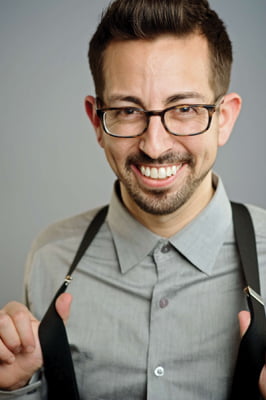

We know him as Kumar in the “Harold & Kumar” movies, but Kal Penn has spent the past two decades happily refusing to stay in one lane: He left acting for a stint in the Obama administration, returned to Hollywood and, in 2021, wrote “You Can’t Be Serious,” a memoir that many assumed was partly his coming-out story. Now, in his new film, “Trust Me, I’m a Doctor,” he plays Dr. Sandeep Kapoor, a gay doctor who finds himself pulled into Anna Nicole Smith’s orbit.
Penn has always been an interesting one for our community to claim: not a splashy, front-of-the-parade gay icon, but someone whose openness has arrived gradually, through a memoir chapter here, an interview there and the occasional reminder that yes, Penn is gay.
Recently, we talked about Anna Nicole’s chaotic bar magnetism and why his book made straight women love him more than gay men did, and — because I had to ask — how often queer stoners recognize him. (Spoiler: not as often as the lesbians do.)

When you look at the path your career has taken, does it surprise you where you’ve ended up?
This is a really good dinner party question, and I’m going to have to remember it just for other actor friends of mine. I remember there’s one episode of “Law & Order: SVU” that I did back in the day, and it was after I had done a bunch of these comedy movies, and I played this rapist.
I remember some of the feedback from that and from friends of mine was like, “Well, you’re obviously the rapist if you’re doing one episode of SVU.” I was like, “Come on, don’t I also get to play the terrible rapist?” But the sentence, “I feel really lucky to play a rapist on SVU,” is the wrong sentence.
It’s the breadth of the work, right? It’s about not always being the Kumar character.
Yeah. And look, I love playing him too. I just think that the characters that are the farthest departure from who you are in real life, at least for me, are always the more interesting ones. And so, playing a doctor of questionable ethics over the course of the film was, for me, really interesting, because it was very juicy about all of the bad decisions that he made.
What was your approach to playing a real person?
I don’t think I’ve ever played somebody who was still alive. The real Sandeep wrote a memoir that the script was based off of. So, at first I had access to this memoir, which is obviously from his point of view, but then he was really open about letting me shadow him and asking all sorts of questions.
He said, “I’m such a big fan and I’m so glad it’s you who will do justice to my story.” I said, “I got to be honest with you, that’s not my job. My job is to do justice to the character as written in the script.”
There’s this scene where he, in real life and in the film, bought the practice that Anna Nicole Smith was already a patient in from a doctor who was retiring. So, he inherited both her as a patient and, at least at the initial time, her dosage of whatever she was getting prescribed. And you see in that first scene, he’s so enamored by her and her celebrity and her fame. And this is that ’90s into 2000s era of L.A. I don’t know very many people who would be so open about that flaw and how it might make you think differently than you would otherwise. It was that vulnerability that I was most interested in.
You’ve crossed paths with Anna Nicole Smith before this movie. What was it like to return to those memories and then spend months inhabiting a story connected to her?
I lived in L.A. at the time that her reality show was on. It’s not like I was friends with her or saw her all the time. But there was one particular party that I was at. I remember people being like, “Oh, there’s Anna Nicole Smith,” and cameras around her. She did not appear sober, but I was at the end of a bar. It was like an L-shaped bar, and I just remember her making out with every person down the bar with her cameras in tow. I was at the end and I got out of the way, because I was like, “Through the transitive property of making out, I don’t want to make out with these 14 people.”

I was going to ask you what makes her a gay icon, but that specific anecdote makes me think, well, there you have it: the ability to walk down a line of people and make out with each one of them.
[Laughs.] Yeah, I don’t even know what kind of bar it was. If memory serves, it was women and men.
- Advertisement -

You and Abbie Cornish, who plays Anna, actually filmed some scenes during WeHo Pride. What was it like to be telling Anna’s story in the middle of an actual Pride event?
I remember there was an email that we got that was like, “Hey, the parade organizers are wondering if after we shoot once through, if you and Abbie can go in the parade in a car and wave to people?” Abbie was like, “There’s no way to get out of hair and makeup fast enough as Anna Nicole Smith and then back into Abbie hair and makeup to do this.” And I was like, “I look like a 2002 doctor who is about to be on trial. I don’t have my beard, not looking my best. There’s no reality in which I’m marching in a Pride parade not looking hot. I’m sorry. Call me in a couple of years and we’ll do it.”
Sandeep is a gay man whose private life becomes public at a time when that kind of exposure could carry very different consequences, and you can see glimpses of that in the film. Did his sexuality change the way that you approached him or what he stood to lose?
It’s an interesting question, because it’s such a small part of the film, but of course in all the research I’m like, there’s a scene with Sandeep and his dad where he has this kind of emotional break and says, “I lie about everything.” And on the litany of things that he tells his dad he’s been lying about, he kind of squeezes in, “And I’m also gay.” And I thought, “What was this like for you?”
More than his sexuality, I thought the more interesting part was when he’s at Pride with Anna at the after-party, that’s based on a real thing, obviously. And Sandeep was saying, look, for him, he would go to the Abbey all the time with friends. It was not a strange place to end up. It certainly wasn’t a coming-out experience for him, but this was the first time he went with somebody who was recognizable, and so it made him feel seen.
You’ve talked pretty openly about coming out. How do you feel about the way that people talk about your coming-out story?
I wrote a book in 2021. Editors love what they call “palate-cleansing chapters,” and one of them was about how my partner Josh and I met. It’s about Coors Light and NASCAR. I was a bit naive, because we’d been together, I think, 12 years at that point and certainly I was out and open professionally and personally and all of that. I just thought this story is funny because it’s about a first date gone wrong. Then the book comes out and every article is like, “Yay, Kal Penn announces massive gayness in gay book.”
Then you look at the reviews of the book and straight women love the book, straight dudes love the book. Gay guys are like, “This book sucks. There’s nothing gay about it.” In retrospect, I should have given that chapter to the New Yorker six months in advance.

I think the queer community is still just desperate for representation so it’s like, “Oh, Kal Penn came out.”
Yeah, which I totally understand. I will sound like a broken record because everybody says this, but anytime there’s more visibility for anybody in the community, it’s a great thing. And it’s also nice that none of us really have the same journey or story and there’s no timeline on it or any of that. But the moral of the story is: Give your chapter to the New Yorker first.
There’s been talk about an upcoming “Harold & Kumar” movie. What do you think has changed with Kumar in the years since the last movie, and what excites you about getting back to these characters?
I love those characters. I love comedy. That’s obviously how I started in my career, and it’s still my first love. So, I hope we get to make the movie. I know they’ve written a script, which I recently read, and it’s hilarious.
I remember 20 years ago when the first one came out, you’d be like, “Oh, it’s probably just people in L.A., New York, San Francisco that are going to watch this stoner movie with two Asian American dudes leading it.” And then everybody forgets the movie came out and completely tanked at the box office. A few months later when it came out on DVD, people were buying this DVD in Milwaukee and Tuscaloosa, Alabama, and it was definitely not just the coasts, and it definitely wasn’t people who looked like us. It was truly every walk of life.
How often do you get a gay stoner that comes up to you and tells you that they loved you in that movie?
I’ll be honest, gay dudes don’t really watch the “Harold & Kumar” franchise, but I have never paid for a drink at a lesbian bar.