
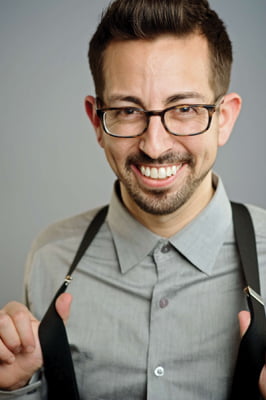

For queer audiences who know what it means to feel unseen, Irish actor Kieron Moore’s performance in “Blue Film” offers a rare kind of recognition: a character who isn’t reduced to his wounds, his sexuality or his mistakes, but allowed to be fully human.
In the film, now available to stream on VOD, Moore stars as Aaron Eagle, a charismatic gay cam performer whose carefully controlled online persona begins to unravel when an unexpected connection from his past (played by Reed Birney) forces him to confront desire, intimacy and the emotional distance he has cultivated from the people around him.
The provocative new drama, written and directed by Elliot Tuttle, has courted controversy for its explicit content, taboo subject matter and difficulties securing acceptance at major film festivals despite strong audience reactions. And Moore’s role demands vulnerability and a willingness to sit inside uncomfortable questions rather than provide easy answers. So much rides on his performance that, if the audience doesn’t believe that Aaron (whose real name is Alex) is a fully realized person, the whole movie falls apart. It’s a different kind of challenge for Moore, who portrayed Nicholas Slovacek, a violent, deeply homophobic criminal, in Netflix’s acclaimed series “Boots.”
Recently, Moore spoke about stepping into a queer story as a straight actor, the conversation and controversy surrounding “Blue Film,” and the surprising parallels he sees between Aaron and Nicholas — two seemingly opposite characters who, in Moore’s view, reveal different facets of performative masculinity.

How much pressure did you feel carrying a character who has to hold so many contradictions at once?
It’s a luxury, really. It’s definitely made it harder now for me when I’m navigating the next job. I think Elliot’s writing is so strong that so much of it was already there, but it had so much room for me to paint my own picture and bring my ideas to it.
A lot of writers feel quite protective of their characters that they write. Elliot obviously was with Aaron and Alex, but he just handed them over. That’s a real relief as an artist. You go, “OK, I’m trusted.” It’s so relieving now to hear that people are having this interpretation of my performance. Of course, there’s conflicting opinions from different audience members, but that just makes it, for me, all the more fruitful.
- Advertisement -

Did you have any idea how controversial this film would be when you got the script?
Honestly, naively, I didn’t. Looking back now, that was idiotic. I just immediately was like, “This is such a strong piece of writing.” I’m very lucky to play the characters I’ve played, but I know that none of them had the opportunity to be exploited in this way, for the camera to sit with me as much as it was going to sit with me as Aaron. So, I think I was just so magnetized to that opportunity of like, can I do this? It wasn’t until we started to submit to film festivals where I was kind of like, “Oh yeah, we’ve done this thing that is terrifying to people.”
When Sundance rejected the film — I’m assuming because of the content itself — what did that feel like?
I’ve always said that the process has always been the point for me. It made me feel like, “Well, maybe this is just the journey.” I just had a feeling it would all work out, and it seems to have been carving its own way now. Audiences are going “Who are these people to tell me that this movie wasn’t OK for me to watch?” That’s quite exciting. It’s its own success story now.
As a straight actor working with a queer director, what was the most valuable insight that Elliot gave you about Aaron and the world that he inhabits?
There were different stages. When they first offered me to do it, I really challenged Elliot: “Are you sure?”
A good question that every straight actor should ask at the beginning of a production like this.
Absolutely. Obviously, I’m very lucky that I’ve got a lot of friends in the gay community, and I’ve been so welcomed by the gay community, but to step into these experiences and to try and live through it is no small task. It’s a big honor. I pleaded, “You’re going to have to defend this choice, that’s something you’re going to have to be OK with.”
And [Elliot] never ever shied away from that.
He would give me certain pieces of music to listen to, to understand where he thought Aaron sat, and then it was all about my interpretation. We bonded a lot on books and our own tastes, and a very specific book, which means so much to me: “Nausea” by Sartre. Elliot loves that book too, and it was kind of like, “OK, I know this person, I know where his brain sits.”
When I met Elliot, I knew that there was a lot of Aaron in him. There’s an extension of himself in that character. So, once I met Elliot, I was like, “I think I’ve got my final colors to add to this painting now.” So, it just morphed into this thing. Where I tried to crack [into] Alex, Elliot just sort of held my hand the whole time. It was really intimate, in a beautiful way. Elliot wouldn’t watch from the monitor; he’d be in the room. And I’ve always said this: I know a lot of actors talk about the audience, and the audience is the reason why we make films, and the reason I get to do this. But as far as filming goes, my audience is the director. The director can worry about the audience at that moment. If I worry too much about the audience when I’m doing it, I’m going to be so in my head.
In this film, there is unexpected tenderness that caught me off guard. When did the emotional parts of the story hit you?
The script is special, and my imagination is strong enough from the amount of reading that I do that I saw this movie whilst I was reading it. But then when you do it, it becomes this whole other beast. It’s fascinating because as Kieron, the story impacts me way more, and I was really struggling with my sympathy as Kieron. Because Reed is so phenomenal as an actor and such a kind human being, when he was performing, I found myself struggling to cling to Aaron’s stubbornness and dismissiveness of this man in ways. Kieron wanted to embrace him and be like, “I wish I could hug you.”
I think if you truly listen to this piece on what’s being said, or you truly sit with it and try to be as unjudgmental as possible, which is a real challenge, it’s quite hard to deny that it moves you. It’s interesting because it highlights our own sort of moral limitation, but in a way we can also strengthen our own understanding of it.

That first scene really grabs you. How much research did you have to do to really understand gay camboy culture and sex work?
Thank you, because that first scene was my most challenging scene, for different reasons. So, I’m glad it sells. You do know what you’re getting, and you’re kind of dared, which I think is exciting. Every time I watch it, I’m like, “Is this getting longer?” [Laughs.] But I’ve got so many wonderful [queer] friends around me and my acting coach is a gay man that grew up in a different time and faced different challenges. But you come to realize that attraction is attraction and something that is primal in us.
Once I felt brave enough, and that was massively because of Elliot, I just let loose. There is a real weird metaphor when it comes to the first scene in the sense that there’s a screen between Aaron and his audience. It’s like he’s being watched, but in a way that he controls. He doesn’t feel he’s being perceived, which I think is interesting. He’s telling you what you see.
It’s like this Zoom right now. I’m just looking at you, and it’s like as much as we’re having this conversation, it drops this veil of myself. Whereas, if that was open and you’re conscious of it, I think it’s quite unsettling and you become very self-aware. That’s not who Aaron is. He’s masked himself. It’s all a lie, I guess.
A lot of people have this idea about me and it couldn’t be further from the truth. I’m actually quite an insecure person, other than when I’m acting. I feel so powerful stepping away from Kieron. But there’s a line in the film where Aaron says, “If you look like me, you’d want to be naked all the time too.” That is so untrue. I love having my clothes on. [Laughs.]
Some true acting happening there, then.
It’s true acting. That opening sequence, it was like, “Can I convince myself that I’m doing this thing?” But then after one or two takes, it really was quite intoxicating.
Both “Blue Film” and “Boots” explore performative masculinity. Is that something that you’ve consciously been drawn to explore in the projects that you take on?
Look, I’m very happy to get the opportunity to explore these characters, and hopefully explore myself in that way. But I would also really love it if we could get more examples of positive masculinity. I think the link between “Boots” and “Blue Film” is really interesting. I’ve always liked to think that my characters are quite different. I went from playing this super homophobic, straight criminal to Aaron Eagle, right? And both of them have the same weaknesses: love, capacity and incapacity. But they both use the same tools. I think it’s really fascinating because I think out of all of them, they’re probably the most similar, which is wild because I think Slovacek (from “Boots”) would probably look at Aaron and be fascinated, and be like, “Hey, you abuse these men online for money, and I do it for free. What’s going on here?”
It’s two sides of the same coin. I say this sentence a lot: The similarities make all of the difference when it comes to people. If you really look at us under a magnifying glass, we’re all living the same life in different colors.