
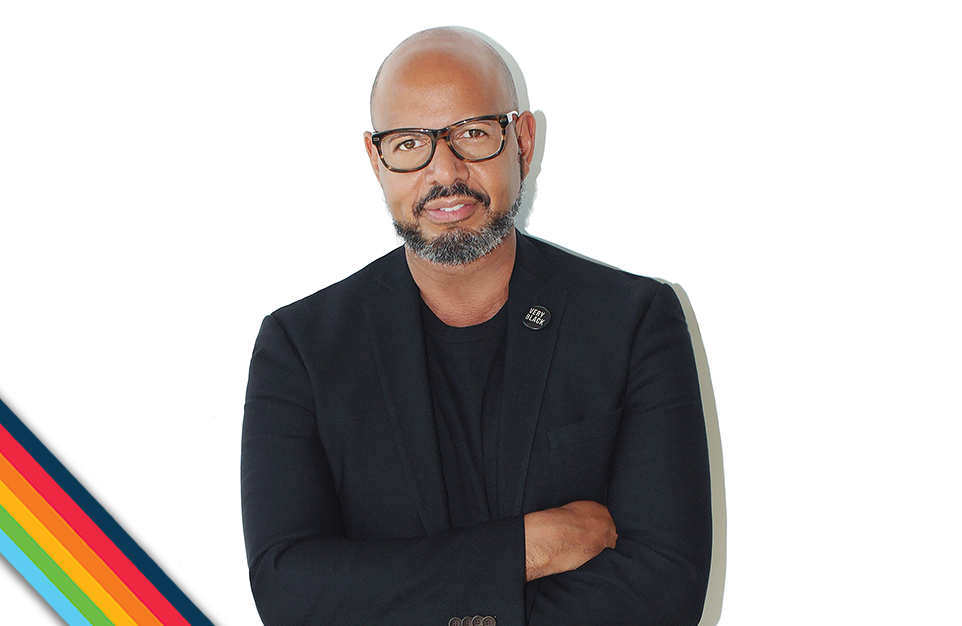

Sex scares me. As a teenager, at a time when most young men were starting to physically connect with their new, exciting, primal sexual desires, the blood in my body was flowing through my veins just as fast. There was nothing unusual about puberty.
Except that my desires were for other men.
I had no references, images or examples. No place to go, and no one to talk to about these feelings. My resources included a pamphlet from my godmother on men’s bodies. I clung to a passage in it on how common it was for teenage males to have sexual desires for other males, but it was usually a phase, and you grow out of it. Then there was my mother’s copy of “The Joy of Sex,” hidden in the right bottom drawer under negligees and lingerie, and a funny plastic disc which I later discovered was a diaphragm.
Then there were the homoerotic shoots of beautiful, hypersexual models in the pages of GQ. And Greg Louganis at the 1984 Los Angeles Olympics. His Adonis-like body, wearing a tight red bikini brief, is standing on the diving board, preparing to dive in. And there was Gene Anthony Ray on “Fame,” his incredible dancing prowess only matched by his swagger bursting out of his muscular body.
And then there were headlines in the newspapers and on broadcast news, about “the plague” or “the gay cancer.” AIDS.
My earliest thoughts about sex were nestled between puberty, promiscuity and “the plague.” All fueled by respectability politics and the silence, stigma and shame fostered in the Black church.
The U.S. government had also been largely silent about HIV and AIDS. It wasn’t until 1987, near the end of his second term, that Ronald Reagan finally addressed AIDS as “public health enemy number one.”
In 1985, I was a freshman at Hampton University when Rock Hudson died of AIDS complications. He was 59. This was the first time AIDS was referenced in a big media story. It was sobering, resounding and terrifying. The disease that was claiming the lives of so many gay men — The Lost Generation — had a profound impact on my life and psyche. If I were to live my truth as a Black gay man, it could be a possible death sentence.
Would I live in the closet and remain alive, or come out and risk everything to be comfortable in my own skin and live my truth if only for a few years? Heavy stuff for an 18-year-old. Sex became a game of roulette. And anal penetration was not an option.
Today, I am 58 years old. A year younger than Rock Hudson when he died. I didn’t survive unscathed. I am what is called a long-term survivor. I was diagnosed with HIV in 1997 — 28 years ago. I am living with the virus, but thanks to modern medicine, I am what is called undetectable. According to the CDC, a person living with HIV who is on treatment and maintains an undetectable viral load has zero risk of transmitting HIV to their sexual partners. Still, many people don’t fully understand this fact or believe that it is untrue.
I’ve been on dates and often bring up my HIV status early in the conversation so that I am being honest, transparent and vulnerable. On more than one occasion, I have had the date tell me they aren’t interested in someone who is HIV-positive or they indiscreetly ghost me. There have also been situations where the person wants to make a go of it but finds it challenging because they can’t unhear my status or they don’t want to risk the “nonexistent” possibility that they may contract HIV.
Living in this reality in 2025 is frustrating and demoralizing.
I founded Native Son as a community and platform created to inspire and empower Black gay, queer and gender-nonconforming men to amplify the voice and visibility of our community. I considered the gap in our history because of the massive loss of life due to the AIDS crisis. We lost a generation of Black artists, actors, dancers, innovators, builders and many more whose lives are unknown and whose existence was extinguished, eliminated and evaporated. We lost our griots (African storytellers), mentors and teachers, along with our uncles, brothers, fathers and history. Native Son created a community where Black queer men could mentor, learn from, support and nurture one another. We could stand in the gap. We could also be a sacred space where our lives, legacies and existence are honored, celebrated and remembered.
At the first Native Son Awards in 2016, I shared my HIV status publicly for the first time. It was imperative that if I were leading and serving a community of Black queer men, I be transparent about my status. It was one of the hardest things I’ve ever done and one of the most rewarding. The challenge was that I hadn’t told my mother that I was HIV-positive. That weekend, I flew home to tell my mother the secret I had hidden for 19 years. But a mother’s love is like a lifeline, and I was grateful that my mother loved me beyond the limits of her own prejudice.
World AIDS Day, observed annually on Dec. 1, is a time for us to remember the 44.1 million souls who have died from AIDS related causes since the start of the epidemic. It is also a moment to have open, honest, loving and healing conversations about HIV within and beyond the Black community. Particularly, when:
- Black people are 12% of the U.S. population, but account for 39% of HIV diagnoses.
- 1 in 2 Black gay or same-gender-loving men may face an HIV diagnosis.
- Black women make up 50% of HIV diagnoses among cisgender women
- Black Transgender women face HIV rates more than 3x higher than other groups.
We don’t have to be pathological; we can actually be a community of care. HIV is preventable and treatable. We have the power to break the cycle and heal our community daily.