
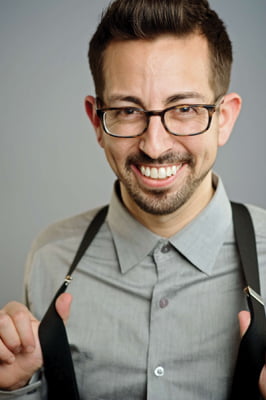

Kevin Williamson knows fear. He’s been shaping it, scripting it and watching it slice through movie theaters for 30 years. But with “Scream 7,” he’s doing something new: directing it himself. For the first time, he’s revisiting the world he helped create in 1996 — when Neve Campbell introduced the world to the ultimate final girl, Sidney Prescott — and seeing it all through his distinctly queer perspective.
In the new “Scream,” Sidney is finally living the life she fought so hard for, settled into a quiet town far from Woodsboro and the trauma she survived there. But peace, as “Scream” fans know, never lasts. When Ghostface resurfaces, the threat hits closer than ever — with Sidney’s daughter (played by Isabel May) now in the crosshairs.
I sat down with Williamson to talk about why the horror genre spoke to him as a gay kid in North Carolina, bringing openly queer characters like Mindy to life and why the final girl still hits so hard for queer audiences, even decades later.

How did stepping behind the camera for the first time change the way you relate to these characters and the themes you’ve carried for decades?
I feel like everything has led to this. I always wanted to direct one of these. Even Wes [Craven, who directed the first four “Scream” movies] was like, “You should direct one of these.” I’m like, “Well, OK.” And then it all sort of never happened and life never materialized for this for me until now. And it seems like this is the time. When Neve called and asked me to direct it, I was like, “Oh yeah, absolutely. If I’m ever going to direct one, this is the one to direct.” The Sidney Prescott story, that’s the one I think I can tell and that’s the one I should be telling. And so it all sort of worked, it was kismet.
When we spoke in 2022, you revealed to me that Billy and Stu were based on real-life queer killers, Leopold and Loeb. That story became one of our most-read pieces ever. I’m wondering why you think audiences are so fascinated by the idea of a romantic or sexual connection between Stu and Billy?
When you take a knife and stab someone, that’s a very intimate act. And I think if you have two people doing it, there’s an intimacy there. And there’s a lead and a follower and that creates a relationship. I just think it’s a very interesting dynamic. I can understand why it’s fascinating. I was fascinated by Leopold and Loeb when I did a school report on them. That’s how I knew about them, because I was always sort of obsessed with the macabre and I thought, “What an unusual story of one person wanting to kill and the other one just wanting to do it to make the other one happy.” It was just such a bizarre relationship. And I thought, “Well, let’s make Billy and Stu bizarre, let’s make them crazy.” And so I kind of just went down that road. I thought it was a fascinating journey.
- Advertisement -

When I interviewed Neve, she acknowledged a “burgeoning love relationship” between Billy and Stu. How do you categorize their relationship?
As a queer writer, my love for horror films comes out of being that gay kid in a small town who was always trying to escape his world. So I really understood the plight of the final girl. I really always connected to Laurie Strode in “Halloween.” I felt like I was always running for my life. I think that’s true for a lot of young gay kids, and that’s why there’s such a subgenre of a gay audience for horror films, which I’m happy to be a part of. And so when I sat down to write [the first one], it was just my way of expressing myself. It’s a little bit of my queer-coding, so to speak.
Beyond just Stu and Billy?
Oh, it’s in the characters of everything I write. I’m a gay writer, so there’s no escaping it. There’s a reason Dawson and Joey [in “Dawson’s Creek,” created and written by Williamson] are named Dawson and Joey.
Would you go as far as saying that Stu or Billy is queer?
No, I think it’s just queer-coding. I do think there’s a love story there in the way that you can make of it what you want. But I do think there’s definitely a love story between these two guys, these two killers. And whether it’s platonic or not, that doesn’t really matter: They’re crazy.

You’ve told me you were a “shy, little gay writer” who wasn’t sure how much of himself he could put on a page. As you revisit “Scream” now, what freedoms do you feel that the younger version of you didn’t have?
We’re in such a different world now. I was much more of a closeted writer back then. I was afraid I couldn’t express that part of me, always trying to do a subversion of it. But now the world and society has progressed in such a manner that we have Mindy [played by Jasmin Savoy Brown] at the front. The fact that she’s gay is just one more part of the story. It’s not a coming out story; it’s not focused on that. It just is. And I like that — when characters just are who they are and they’re allowed to be who they’re meant to be.
Knowing how queer-coded you had to be at the beginning of your career, how does it feel to direct an openly queer character like Mindy?
I loved it. I mean, that was one of the greatest things. I found it so emotional for me as a gay writer, and I was so happy that we have this character now in the franchise. And I was happy that I got to write her this movie. I got to bring voice to her, and so it was exciting. It was an exciting thing for me to be able to write Chad and Mindy. This was my first chance to write those voices.
Matthew Lillard’s Stu obviously has a massive queer following. When you think about him now, decades later, how do you understand his interior life differently than you did in 1996?
It’s so hard because now… well, Stu’s dead. He died in the first film. Or did he? I know Matthew Lillard, I know him as a human being. I know what a special, wonderful human being he is. And so that’s who I know and Stu is just dead. I know I’m being… I can’t answer this.
I imagine this whole press junket is a challenge for you in regards to how much you should and shouldn’t reveal.
Stu who? I was hanging out with Matthew on Saturday night and he goes, “You know what? People keep asking me. I haven’t even been confirmed I’m in the movie.” I go, “Well, I’m pretty sure the poster’s coming out with your name on it.”
Do you think your own queerness has sharpened your understanding of vulnerability — who’s allowed to survive, who isn’t and how you see that within the “Scream” franchise?
Well, I mean, by the question alone, I feel like the answer’s yes, but it’s my DNA. It’s who I am as a human. And so when I sit down to write, I couldn’t even begin to tell you what part of it is which and which is where. But I do think it is part of everything I do. It’s the best part of me.

In that sense, is there a “Scream” film that has the most “you” in it?
I would say the first two because they were written so close together. The story for “Scream 2” was already developed by the time “Scream” was written. And so it was one of those things that had been in my head for years, and then it came out in three days on the page, but I had been thinking about it for a much longer time. And I think it was probably the true representation of who I was at that time. And “Dawson’s Creek” was the other one. I think because it was all at the same time, I just got it all out at the same time, all the thoughts that were in your head for so long.
Why do you think so many queer viewers see themselves in Sidney?
I think it has to do with the final girl. Certainly as a gay man, I think we can relate to the final girl. We know what it’s like to survive, or sometimes we always feel like we’re hiding who we are and we can’t be our true selves and we’re always running and hiding and trying to escape from being exposed. I think that’s why the horror genre in general lends itself to the coming out story. And she’s fierce and she’s awesome, and she’s everything that we long to be. I mean, I want to be as fierce and badass as Sidney Prescott.
And obviously, we have seen her trajectory and the evolution of somebody who has just grown stronger and more fearless. It really resonates.
Neve Campbell has shaped that performance because that’s who she is, and so it’s like a marriage of actress to role. She’s been this character for 30 years and we’ve watched her all the way through. This is like one more facet of her, seeing her as a mother. If you think about Sidney’s childhood, it’s not something you want to talk about. It’s like, “Oh, mom, what was your first time like?” “Well, it happened on the night that all my friends were murdered.” There’s not a good backstory there for her to share. And so it’s like, how do you parent when you can’t share your true self with them? And it’s, what kind of disconnect does that create and can it be overcome? And what happens when Ghostface comes calling?
Neve just carries a kind of emotional truth that can’t be replicated. As a gay writer, what has it meant to you to reunite with her as this sort of embodiment that queer people relate to?
I’ve known Neve for 30 years now. We’ve been great friends and we just became greater friends making this movie and we had such a great time. One of the things I love so much is watching her relationship with Isabel May, because casting Sidney’s daughter, we wanted to find someone who had the gravitas that Neve has.
Sidney’s been through so much, there’s a weight to her. And so her daughter probably has a weight to her, too. And so we found this amazing actress who is spectacular and they’re so connected in the movie; it’s a really great relationship. It’s really fun to watch Sidney Prescott be a mother in her Sidney Prescott way, and to watch her daughter, you sort of realize, “At what point is she not going to take any shit either?” Is she going to become a badass? It’s kind of like the birth of a final girl.
As much as I want more “Screams” after this one, I also do want Sidney to just rest. She did nothing wrong. She does not deserve this.
[Laughs.] I agree with you. I think she deserves happiness, but what you do see in this film is she has found it.